


The Value of Diabetes Self-Management Education and Support (DSMES)
Diabetes care is complicated. DSMES helps people manage it successfully.

What is DSMES?
People with diabetes make dozens of decisions daily that affect their health, from food choices and physical activity to medication use, glucose monitoring, and problem-solving. Diabetes self-management education and support (DSMES) is an evidence-based service that helps people with diabetes develop the skills needed to manage their disease throughout life. It combines clinical guidance, education, behavioral support, and problem-solving strategies tailored to an individual's needs, goals, culture, lifestyle, and health status.
DSMES helps people with diabetes learn how to:
- Eat healthy and make informed health choices
- Incorporate physical activity into their daily lives
- Monitor and interpret glucose data
- Take medications safely and effectively
- Reduce the risk of complications
- Solve diabetes-related challenges
- Build healthy coping strategies and resilience
The Evidence is Clear: DSMES Improves Outcomes
For decades, research has demonstrated that diabetes self-management education and support (DSMES) is one of the most effective interventions available to help people successfully manage diabetes. Across numerous systematic reviews, meta-analyses, and professional consensus reports, DSMES has been shown to improve glycemic outcomes, strengthen self-management behaviors, enhance quality of life, and support healthier coping. Evidence also suggests that participation in DSMES may reduce preventable hospitalizations and contribute to more efficient use of healthcare resources.¹⁻¹¹
The benefits of DSMES extend beyond education alone. By helping people develop the knowledge, skills, confidence, and problem-solving abilities needed to manage diabetes every day, DSMES empowers individuals to become active participants in their care and achieve better long-term outcomes.¹,²,³
Below are some of the key ways DSMES improves outcomes for people living with diabetes.

Better Glycemic Management
Multiple systematic reviews and meta-analyses have demonstrated that DSMES leads to meaningful improvements in A1C and overall diabetes management. Recent evidence shows that participation in DSMES is associated with clinically significant reductions in A1C compared with usual care 2-4
Stronger Self-Management Skills
People who participate in DSMES gain the knowledge, confidence, and practical skills needed to manage diabetes more effectively. Research has shown improvements in self-care behaviors, diabetes knowledge, medication management, healthy eating, physical activity, and self-efficacy. 4-5

Improved Quality of Life
Living with diabetes can be physically and emotionally demanding. DSMES helps people build healthy coping strategies, reduce diabetes-related distress, increase confidence, and improve overall quality of life. 1

Potential Reduction in Hospitalizations
Studies have shown that diabetes education is associated with fewer hospitalizations, lower readmission rates, and reduced healthcare utilization. 6-8

High-Value Care
By helping people avoid complications, improve self-management, and navigate treatment changes more effectively, DSMES contributes to higher-quality, more cost-effective diabetes care. Economic evaluations have demonstrated favorable value and potential healthcare savings associated with diabetes education programs. 8-10
The Difference a Diabetes Care & Education Specialist Makes
While DSMES is valuable on its own, diabetes care and education specialists (DCESs) bring specialized expertise that helps people successfully apply what they learn in real life.
DCESs are trained to provide person-centered care that addresses the clinical, behavioral, emotional, cultural, and practical aspects of living with diabetes. They work alongside healthcare providers to help individuals understand their treatment plan, overcome barriers to care, and build lifelong self-management skills.¹¹
DCESs help people:
- Turn medical recommendations into achievable daily actions
- Navigate diabetes technologies such as continuous glucose monitors and insulin pumps
- Address barriers related to health literacy, culture, financial concerns, and social determinants of health
- Build confidence and problem-solving skills
- Adapt to changes in treatment, health status, and life circumstances¹
DSMES is Most Effective When It's Ongoing
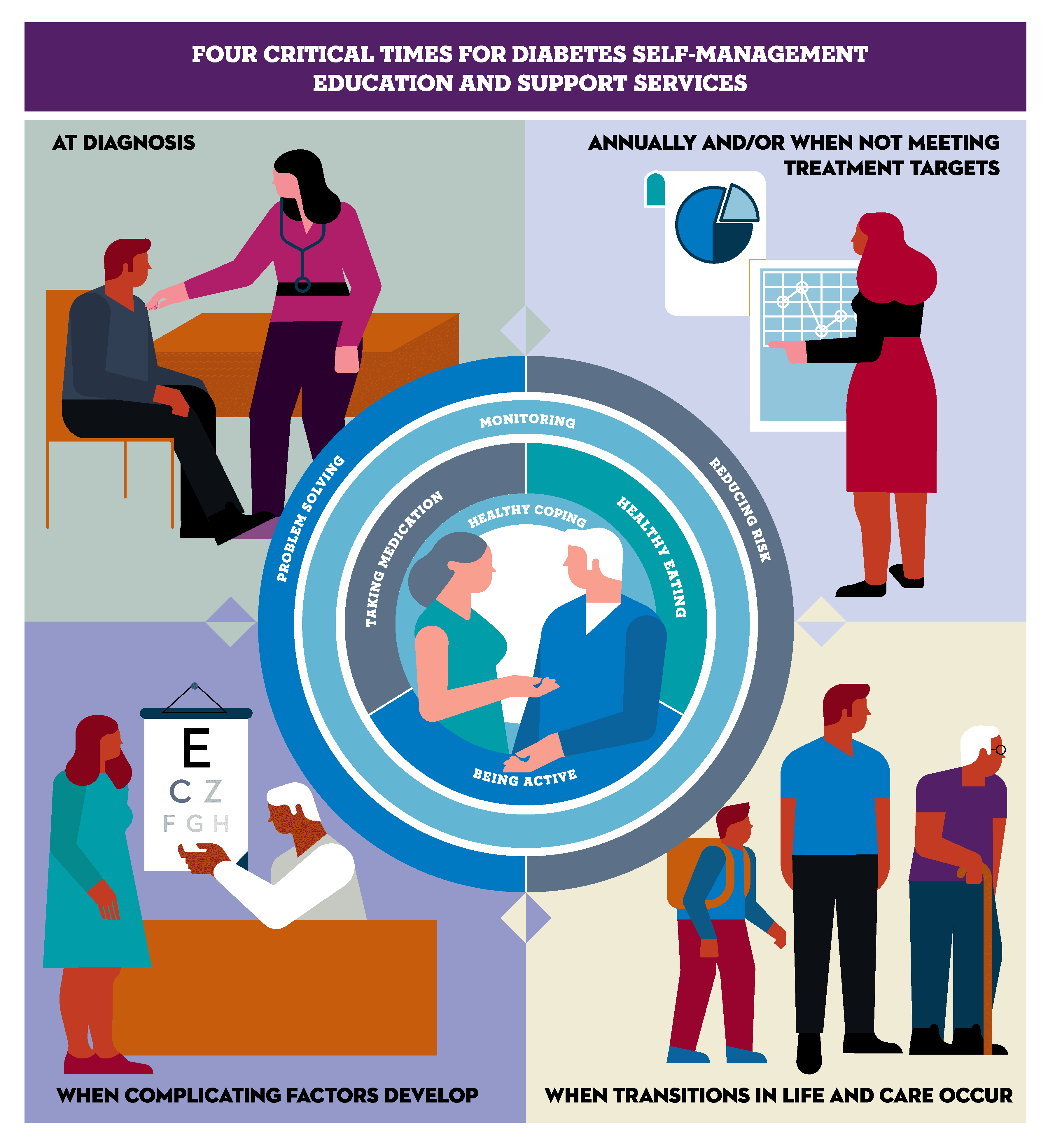
ADCES and a consortium of experts recommend DSMES at four critical times:
- At diagnosis
- Annually or when treatment goals are not being met
- When complicating factors develop
- During transitions in care and life circumstances¹
Regular access to DSMES helps people stay engaged, adapt to changing needs, and maintain effective self-management over time.¹
Why DSMES Matters
As diabetes becomes more prevalent and treatment options become more complex, people need more than information. They need practical guidance, personalized support, and a trusted partner who can help them translate a treatment plan into everyday success.
The evidence shows that DSMES improves health outcomes, strengthens self-management, enhances quality of life, and supports more effective use of healthcare resources.²⁻¹¹ Diabetes care and education specialists help bring those benefits to life through individualized, person-centered care.¹¹
DSMES works. Diabetes care and education specialists help make it work for each individual. Together, they improve clinical outcomes, strengthen self-management skills and support healthier lives for people living with diabetes.
References:
Powers MA, Bardsley JK, Cypress M, et al. Diabetes Self-management Education and Support in Adults With Type 2 Diabetes: A Consensus Report of the American Diabetes Association, the Association of Diabetes Care & Education Specialists, the Academy of Nutrition and Dietetics, the American Academy of Family Physicians, the American Academy of PAs, the American Association of Nurse Practitioners, and the American Pharmacists Association. Diabetes Care. 2020;43(7):1636-1649.
Ma L, Zhao WS, Wang R, et al. Effect of Diabetes Self-Management Education in Type 2 Diabetes Management: A Systematic Umbrella Review of Meta-analysis. BMC Endocrine Disorders. 2026;26:79.
Chrvala CA, Sherr D, Lipman RD. Diabetes Self-management Education for Adults With Type 2 Diabetes Mellitus: A Systematic Review of the Effect on Glycemic Control. Patient Education and Counseling. 2016;99(6):926-943.
Alliston P, Jovkovic M, Khalid S, et al. The Effects of Diabetes Self-management Programs on Clinical and Patient-Reported Outcomes in Older Adults: A Systematic Review and Meta-analysis. Frontiers in Clinical Diabetes and Healthcare. 2024;5:1348104.
Ernawati U, Wihastuti TA, Utami YW. Effectiveness of Diabetes Self-Management Education in Type 2 Diabetes Mellitus Patients: Systematic Literature Review. Journal of Public Health Research. 2021;10(2):2240.
Robbins JM, Thatcher GE, Webb DA, Valdmanis VG. Nutritionist Visits, Diabetes Classes, and Hospitalization Rates and Charges: The Urban Diabetes Study. Diabetes Care. 2008;31(4):655-660.
Healy SJ, Black D, Harris C, Lorenz A, Dungan KM. Inpatient Diabetes Education Is Associated With Less Frequent Hospital Readmission Among Patients With Poor Glycemic Control. Diabetes Care. 2013;36(10):2960-2967.
Silveira LJ, Fleck SB, Sonnenfeld N, et al. Estimated Cost Savings of the Everyone With Diabetes Counts Program. Family & Community Health. 2018;41(2):90-97.
Ye W, Kuo S, Kieffer EC, et al. Cost-Effectiveness of a Diabetes Self-Management Education and Support Intervention Led by Community Health Workers and Peer Leaders. Diabetes Care. 2021;44(5):1108-1115.
Siegel KR, Ali MK, Zhou X, et al. Cost-Effectiveness of Interventions to Manage Diabetes: Has the Evidence Changed Since 2008? Diabetes Care. 2020;43(7):1557-1592.
Rodriguez K, Ryan D, Dickinson JK, Phan V. Improving Quality Outcomes: The Value of Diabetes Care and Education Specialists. Clinical Diabetes. 2022;40(3):356-365.